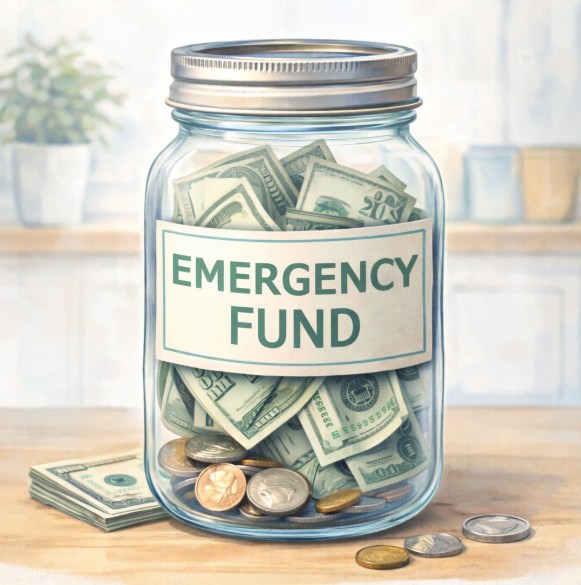
Picture this: your car breaks down, your hours get cut, or you get an unexpected medical bill. If you have no savings, you may have to rely on a credit card or a high-interest loan at the worst possible moment. An emergency fund is designed to prevent exactly that.
This guide explains what an emergency fund is, how much you need, where to keep it and how to build it even on a tight budget.
What Is an Emergency Fund?
An emergency fund is money set aside only for unexpected and necessary expenses. It is not for vacations, sales or new gadgets. Typical emergencies include:
- Job loss or reduced income
- Medical, dental or vision bills
- Urgent car or home repairs
- Emergency travel for family
- Unexpected insurance deductibles
Think of it as insurance you buy for yourself.
Why You Need One
It keeps you out of debt. Without savings, many people turn to credit cards with high interest rates. A small emergency can become a long-term burden.
It reduces stress. Knowing you have a cushion lets you handle surprises calmly.
It gives you freedom. With savings, you can leave a bad job, negotiate from a stronger position or take time to find the right opportunity.
How Much Should You Save?
A common guideline is three to six months of essential living expenses.
First, add up your monthly essentials: rent or mortgage, utilities, groceries, transportation, insurance, minimum debt payments and any other must-pay bills. Leave out wants like dining out and entertainment.
For example, if your essentials total $3,000 per month:
- Three months = $9,000
- Six months = $18,000
Aim for six months or more if you:
- Are self-employed or have irregular income
- Support a family on a single income
- Work in an industry with frequent layoffs
- Have ongoing health issues
Three months may be enough if you:
- Have stable employment
- Live in a two-income household
- Have low fixed costs and good insurance
Start Small: Your First Milestone
Thousands of dollars can feel impossible at first, so start with a starter goal of $500 to $1,000. This small cushion can cover many common emergencies, like a flat tire or a minor medical bill. Once you reach it, aim for one month of expenses, then three, then six.
A simple ladder:
- Starter fund: $1,000
- One month of essentials
- Three months of essentials
- Six months of essentials
Step-by-Step Plan to Build Your Fund
Step 1: Open a separate account. Keep your emergency money away from your everyday checking account. Having it in a different place reduces the temptation to spend it.
Step 2: Choose a realistic monthly amount. If you can save 10% of a $3,500 monthly income, that is $350 per month, or $4,200 in a year.
Step 3: Automate it. Schedule a transfer right after payday. Automation removes the need for willpower.
Step 4: Save windfalls. Tax refunds, bonuses, birthday money and side income can jump-start your fund.
Step 5: Redirect cut expenses. When you cancel a subscription or lower a bill, send the savings straight to your fund.
Step 6: Earn extra income. Freelancing, tutoring, delivery driving, selling unused items or weekend gigs can speed things up. Even $200 extra per month makes a noticeable difference.
Step 7: Track your progress. Use a chart or app. Watching the balance grow is motivating.
Where Should You Keep Your Emergency Fund?
Your emergency fund should be safe, liquid and easy to reach. Good options include:
- High-yield savings account (HYSA): Online banks often pay much higher interest than traditional savings accounts. Look for accounts insured by the FDIC (banks) or NCUA (credit unions), which protect deposits up to $250,000 per depositor, per insured institution, per ownership category.
- Money market account: Similar to savings, sometimes with check-writing or debit access.
- Short-term CDs for part of the fund: These may pay more but can have early withdrawal penalties, so use them carefully.
Interest rates change over time, so compare current rates, fees and minimum balances before opening an account.
What to avoid: Do not keep your emergency fund in the stock market, cryptocurrency or other volatile assets. Their value can drop right when you need the money. Also avoid treating a 401(k) as your emergency fund, since early withdrawals can bring taxes and penalties.
What Counts as a True Emergency?
Before using your fund, ask three questions:
- Is it unexpected?
- Is it necessary?
- Is it urgent?
If all three answers are yes, use the fund. A holiday sale, a vacation or a new phone does not qualify. After using the fund, make rebuilding it a top priority.
Common Mistakes to Avoid
- Waiting for the perfect time. There is never a perfect time. Start with whatever you can.
- Mixing it with other goals. Keep your vacation fund and your emergency fund separate.
- Never updating the target. As your expenses rise, so should your fund.
- Chasing high returns. The goal is safety and access, not growth.
- Feeling guilty about using it. That is what it is for. Using it for a real emergency means it did its job.
Emergency Fund vs. Paying Off Debt
If you carry high-interest debt, such as credit card balances, you may feel torn. A balanced approach works well: first save a small starter fund of about $1,000, so minor surprises do not push you deeper into debt. Then pay down high-interest balances aggressively. Once the debt is gone, build your fund to three to six months of expenses.
A Real-Life Example
Sarah earns $3,800 per month after taxes and spends $2,400 on essentials. Her goal is three months of expenses, which is $7,200. She sets up an automatic transfer of $300 per month into a high-yield savings account and adds $100 from weekend freelance work. At $400 per month, she reaches her goal in about 18 months. When her car needs a $1,100 repair, she pays from her fund instead of using a credit card, then begins refilling it. That is the power of preparation.
Final Thoughts
An emergency fund is the foundation of financial security. It will not make you rich, but it keeps you from falling backward when life throws a surprise at you. Open a separate account, start with a small goal, automate your deposits and keep building until you reach your target.
You do not need a high income to begin. You just need to start.
Disclaimer: This article provides general educational information and is not personalized financial, tax or legal advice.
Publish karne se pehle yaad rakhein:
- Rates aur limits (jaise FDIC $250,000, HYSA rates) publish se pehle official sites (FDIC.gov, IRS.gov) par check kar lein, kyunke yeh badalte rehte hain.
- Har article mein apna ek personal angle ya example add karein, taake AdSense ko content unique lage.
- Plagiarism check zaroor karein aur site par About, Contact, Privacy Policy aur Disclaimer pages banayein.
- US audience ke liye hosting/Google Search Console mein target country US set karna madadgar hoga.
No responses yet